Socio-political and Technological Factors in the Political News and Information Flow in the United States
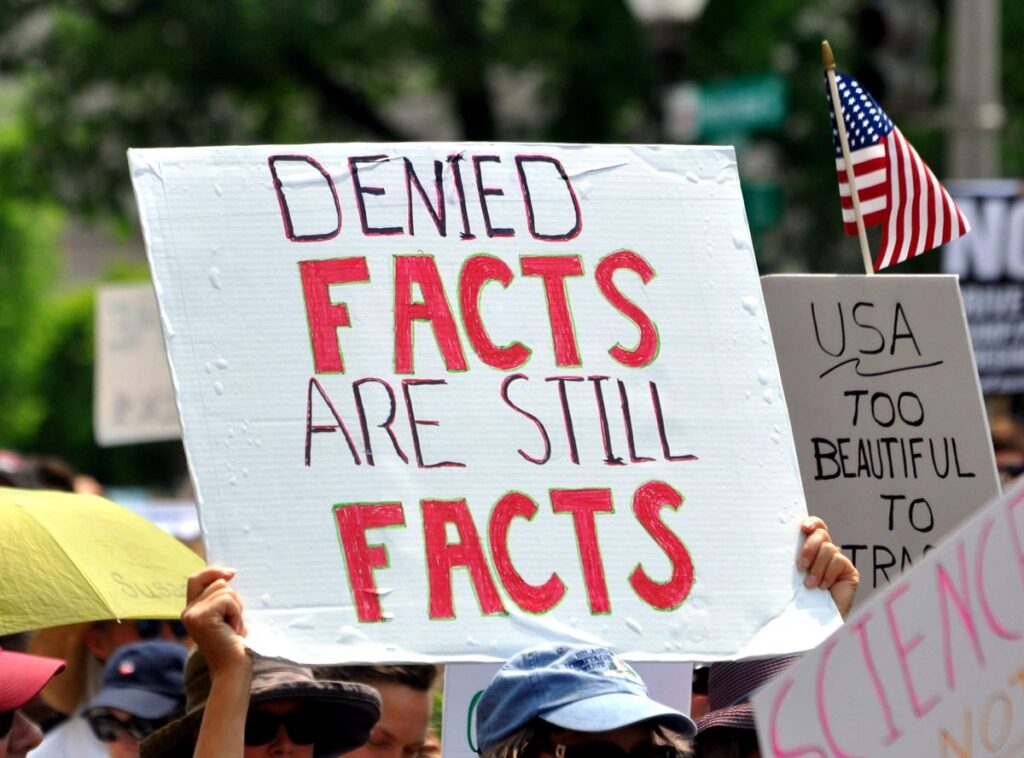
(Archive) People’s Climate March 2017 in Washington, D.C. – Sign about climate change denial. “Denied facts are still facts.”,
Estudos e Analises de Conjuntura n 26_Maio 2026_Sociopolitical and Technological Factors
Second in a Series of Three Articles on the Political News and Information Flow in the United States Today
By Wayne A. Selcher1 [Estudos e Análises] [Media] [Mídia]
The initial article of this series of three is an annotated commentary guide to many non-mainstream and alternative news and analysis sources for scholars of American politics and foreign policy, detailing such aids as bias-rating tools, press freedom and news literacy advocates, international perspectives, and partisan and non-partisan information and analysis sources. The next two segments will build upon that foundation to delineate the major factors and dynamics in current political news and information production and distribution, the news consumption patterns of the public, their consequences for technological and socio-political change, and their effects on the evolving political dialogue and on the news industry.
THE EFFECTS OF POST-TRUTH, SKEPTICISM, AND POPULISM
 “Post-truth” was Oxford Dictionary’s word of the year for 2016, denoting a condition in which emotion and personal beliefs are more important than facts in shaping personal and public opinion. The “death of expertise” was originally identified as a global phenomenon of public skepticism about “experts” in 2017 by Professor Tom Nichols. In 2018 an ongoing RAND Corporation think tank project drew attention to “truth decay,” as “the diminishing role of facts and analysis in American public life.” The social trend of suspicion and doubting of established “experts” in all fields of knowledge and of the questioning of official narratives, such as during the wars in Iraq and Afghanistan, was amplified in the United States by the events and official claims during the 2008 financial crisis, the Covid-19 pandemic of 2020 and 2021, and the slow economic recovery afterwards. The perspective that “they [the ‘elite’] were lying to us all along, for their own benefit” became a more accepted general point of view, which expanded the lucrative online market for doubts, counternarratives, anti-establishment populism, and a wide range of conspiracy theories. Essentially, this phenomenon became the current manifestation of the tradition of anti-intellectualism in America, as identified by historian Richard Hofstadter, in his classic works, Anti-Intellectualism in American Life (1963) and The Paranoic Style in American Politics (1965).
American news channels, such as conservative Fox News and liberal MSNBC (currently rebranded as MS NOW), developed a business model that contributed heavily to encouraging political polarization. In an extensive and detailed 2025 academic paper, “The Business of the Culture War,” Professors Noy and Rao, of MIT and Harvard, use time-series broadcast and polling data to establish that connection. Polls consistently show that the majority of voters by far care the most about the economic and health care issues that affect their own lives. But executives and producers in cable news determined that they could boost audience ratings and gain income by attracting the then-less-engaged viewers if they stressed or dramatized emotional social issues in the identity-driven culture wars, such as gun rights, gender controversies, racial conflicts, political correctness, cancel culture, crime and policing, voter fraud, and undocumented immigration, more than the economic matters.
This market strategy of agenda shift emphasized the promotion of divisive issues and the cultivation of a loyal following, somewhat of a political community, far more than the previously dominant and more sedate style of traditional broadcast news. The switch in programming to a consistent and righteous “us vs. them” tone of urgency succeeded in rechanneling viewers’ attentions, increased viewership and profits, and thereby also helped to promote a vicious cycle of national polarization that still holds firm and is highly lucrative, including in social media and podcasts. Polarization increased viewer engagement, which incentivized more polarizing content. Noy and Rao contend that:
“Cable news’ incentive to center mobilizing culture war content influences politics: constituencies more exposed to cable news assign greater importance to cultural issues, and politicians respond by supplying more cultural ads. Our estimates suggest that cable news can account for one-third of the time-series increase in cultural conflict since 2000.”
News content, flow, receptivity, consumption, and interpretation by the public are strongly influenced by the socio-political climate or mood of the moment, the broader life situations of the larger audience. This context also conditions which topics and narratives drive viewership and online clicks and sales, and so are profitable for the political news and information business. The contemporary U.S. media landscape is marked by thorough fragmentation, digital dispersal, and public distrust of legacy and mainstream sources, creating a tumultuous context that is reshaping national political communication. Most of the major roots of this current attitude and opinion configuration were established by trends developing mainly over the previous decade. Some of these broader tendencies are international in scope and experienced by many countries.
Donald Trump’s Threats to Freedom of the Press
In the United States, over a decade of news cycles has been affected by the anger, victimhood mindset, and vice-signaling of Trump and MAGA, as they break taboos, denounce the establishment and national institutions generally, and promote distrust in those institutions as long as others are in control of them. Trump has a personal and decades-long animosity toward mainstream journalists and the press, which he has often referred to as “very corrupt” and “the enemy of the people,” ironically a Soviet Communist propaganda phrase. He has a history of lawsuits against the critical press, going back to long before he entered politics. As a businessman, and obsessed with “winning” and “being strong,” he was very sensitive to his public image and to any criticism or slights, particularly from the press and in his native New York City. In 2016, when CBS News reporter Leslie Stahl interviewed Trump, she asked him why he repeatedly criticized and disparaged the mainstream news media. She recalled his answer as “I do it to discredit you all and demean you all so when you write negative stories about me, no one will believe you.” That motivation to bend the public dialogue to his favor still holds true as he takes unusual measures against outlets critical of him, such as lawsuits and denial of access.
Trump and the highly active White House communications team famously dismiss any negative reports about him as “fake news” or “hoaxes,” as part of their attempts to dominate and direct the public narrative. His followers believe him and reflexively blame a “corrupt” establishment that “hates Trump” and those who suffer from a supposed and irrational “Trump Derangement Syndrome” mental illness. Trump, his allies, and his spokespersons often explicitly accuse opponents of TDS, rather than answer the criticism directly in a more civil way. Severe distrust of the established media and implicit trust in Trump is therefore an essential hallmark of a Trump believer. Verbal attacks on the mainstream media, including against individual reporters at campaign events, were a constant feature of his 2024 election campaign. Trump and his spokespersons continue to cultivate that attitude with hostile and often snide or petty comments and insults about the mainstream press, individual reporters, and members of media boards.
Punitive attacks on and pressure against the critical press and other critics became a feature of Trump’s second term, from the very start, as part of his drive to remake American culture and the contours of political power. More than in his first term, he is clearly pursuing a highly personalistic retaliatory weaponization of government power and his electoral influence in retribution against his perceived enemies. These include several recalcitrant Republicans and those former officials under Obama and Biden that were involved in investigating or prosecuting him for supposed illegal acts. But Trump denies such a campaign, and frequently cites “weaponization” only as a tactic of the Democrats under Biden. The Wall Street Journal identified “nearly four dozen” such prosecutions by the Department of Justice as of June 2026. The FBI reportedly has a “payback squad” of agents willing to handle such cases.
The White House maintains an ongoing public list of what it regards as biased or lying “media offenders,” and published a denunciation of what it called “a nonstop deluge of hoaxes and lies from Democrats and their allies in the Fake News” in the administration’s first 100 days. Huge quantities of material from former administrations that was deemed to be out of step with current administration policy or negative toward Trump have been deleted from government websites as “partisan propaganda.” This includes legal information pertaining to the January 6, 2021 attack on the U.S. Capitol by Trump supporters and many datasets and analyses condemned as “woke,” about such topics as education, climate change, public health, and foreign aid.
Trump’s ongoing high-profile intimidation strategy against the press often implicitly threatens potential critics ahead of time with drawn-out trials and very costly legal expenses, a clear danger to freedom of the press (guaranteed by the First Amendment to the Constitution) and government accountability. Even though these punitive lawsuits have often failed in court because of lack of evidence of intentional malice or a sound legal basis, they serve as a persuasive deterrent to encourage the press to “fall in line” in anticipatory obedience and to appease him of its own accord or suffer negative financial or regulatory consequences. Trump refers to these highly self-serving actions as “straightening out” the press, ironically while publicly defending freedom of speech at home and abroad. He sometimes complains about conservative commentators who do not always completely support him, as in the case of MAGA divisions over the 2026 war with Iran and policy toward Israel, because he defines MAGA personalistically as full support of whatever he says or does as its leader. But he has not taken action against media outlets that praise him. To the contrary, he interacts with Fox News hosts and commentators frequently on and off-air, values their feedback on his policies and actions, and has selected numerous upper-level members of his administration from their ranks.
His antagonistic actions against press criticism have extended as far as a lawsuit against the BBC for $10 billion for defamation caused by its editing of his January 6, 2021 speech to agitated supporters near the Capitol in a broadcast about him. He also sued the Wall Street Journal for $10 billion in defamation regarding a report about his ties with the deceased Jeffrey Epstein, convicted of sex trafficking of minors, but a judge dismissed the case. There have been threats by the Federal Communications Commission to suspend FCC licenses of media outlets for critical coverage of the war with Iran, for publishing supposed “fake news,” or for alleged consistent liberal bias. The ABC network was targeted for FCC review of its broadcast license because of alleged partisan bias that would violate the FCC’s longstanding “equal time” rule. The Administration ended government funding for the PBS and NPR networks because they were seen as “biased and partisan.” The large Disney network has felt demands from the FCC. Media access to the Pentagon and the White House has been restricted. Specific news reporters and late-night talk show hosts have been targeted. At the system level, American media ownership is becoming more concentrated. Several major transfers of ownership and mergers of principal media outlets have been moving in Trump’s favor, by placing control of those organizations in the hands of Trump’s billionaire allies, such as Larry and David Ellison. Most of these have shown willingness to cooperate with him and to offer donations to his projects ever since his inauguration ceremony.
The country is witnessing an arbitrary, unprecedented, and blatant strategy by intimidation and lawfare to challenge the long-established and mainstream media’s criticism of Trump as biased, inaccurate, and unfair and to re-direct the flow and content of news and official information in the country in ways more favorable to him. On March 13, 2026, Trump boasted on his Truth Social platform that he is “reshaping the media,” proudly detailing specific examples of the concrete results of his threats and actions, which fall far outside of formerly accepted presidential prerogatives. This drive is part of his so far largely successful autocratic attempts to concentrate more power into the presidency, which greatly alters the previous status of the balance of powers among the three branches of the federal government.
The rate and scope of success of his efforts to force media compliance and to control the narrative in his second term have been remarkable and have drawn international attention. Reporters without Borders refers to the results as “shrinking the space” for press freedom. Reuters’ Digital News Report 2026 observed that “Threats to press freedom in the United States have sharpened in 2026 amid civil strife at home and a new US-led war in the Middle East, with President Donald Trump threatening to prosecute reporters for treason. Meanwhile, corporate shuffles endorsed by the White House may augur a lasting rightward shift in the US media landscape.” Very few politicians in the Republican Party have objected publicly, and partisanship on judging the issue is also seen among the public. Pew Research reported in April 2025, before many of Trump’s actions to “straighten out” the press, that 70 percent of Americans were “at least somewhat” concerned about potential restrictions on press freedom in the country. But Democrats (60 percent) were far more “highly” concerned under Trump than were Republicans (28 percent), a reversal of party stances of concern in the Biden years.
Reporters Without Borders’ annual World Press Freedom Index for 2026 ranked the U.S. globally at number 64 for freedom of the press, an historic low in their timeline. For those researchers interested in this vital issue, the nonpartisan U.S. Press Freedom Tracker of the Freedom of the Press Foundation compiles “reliable and contextualized” ongoing information on press freedom violations in the United States, including those by Trump. The Poynter Institute maintains an ongoing Press Freedom Watch, “a list of federal actions affecting journalists, including lawsuits, policy changes, investigations, funding cuts, firings and detentions.”
How the Public Mood Affects the Political News and Information Flow
Both Gallup and Pew Research maintain sections of their websites about public opinion polls on issues regarding the press and the mass media. These are well worth following for the researcher. An October 2025 Gallup poll registered that “Americans’ confidence in the mass media has edged down to a new low, with just 28% expressing a ‘great deal’ or ‘fair amount’ of trust in newspapers, television and radio to report the news fully, accurately and fairly.” Further, “Republicans’ confidence, which hasn’t risen above 21% since 2015, has dropped to single digits (8%) for the first time in the trend.” Sixty-two percent of Republicans had no trust at all in the media in late 2025, and younger persons were more distrustful than older ones. Gallup’s time series graphs on the issue show a dramatic and near-constant decline in trust since 1976, well before Trump’s appearance on the political stage.
Hence a more severely divided, stressed, anxious, and skeptical public approaches, promotes as consumers, interprets, and acts upon the political news and information flow quite differently in 2026 than in, say, 2016. The shifting public mood created profitable incentives for the political news and information media that technological advances were able to support and distribute, including with the promotion of sensationalism and click-bait culture. Socio-political distrust created a demand for alternative information channels, worldviews, and explanations, which widespread smart phone use facilitated, including with citizen-created videos. Beyond just information, many news consumers sought a sense of community or belonging, an engagement and connection that fostered trust in their favorite political news and information providers. Changing technology in the media sphere over the decade both broadened the range and dispersal of available sources and information and accelerated some negative socio-political trends and cycles.
FROM SEVERAL MAINSTREAM GATEKEEPERS TO FRAGMENTATION OF SOURCES
In September 2025, Pew Research noted that “A majority of Americans (62%) say they get news about government and politics extremely often or often,” far more than about other topics such as science and technology, business, or sports. But Americans now get their political news and information from far more varied places than a decade ago, including from sources that did not exist or were obscure in 2016. The expanding number of alternative options increases fragmentation of attention, focus, and message, and has scattered the shape and direction of public opinion, including into information bubbles and niche debates. Quality and veracity of information have also suffered.
The once dominant prestigious mainstream or legacy media (Washington Post, Wall Street Journal, New York Times, Los Angeles Times, TIME magazine, major TV networks, etc.) has a cosmopolitan, educated, urbane, and usually liberal inclination. That staid establishment that used to have a central role for generations in national understanding and agenda-setting is being severely challenged in audience share and finances by more dynamic nationalist and populist media currents that gain attention and audience share from explicitly opposing them as too “elitist,” “irrelevant,” “formalistic,” and “out of touch” for the average American. Many Americans find that change of tone and perspective refreshing because immersion in the newer and larger media flow can become overwhelming and exhausting.
The online media that was effectively deployed in the 2024 presidential election campaign, most heavily to support Donald Trump, proved that “the big media era is over,” as an article in Axios by its CEO Jim VandeHei and Mike Allen expressed it. They referred to the splintered media covering and participating in that campaign as creating a “shards of glass election.” The traditional sources remain very useful to academics for their in-depth analysis of events and their contexts, but they no longer drive the national dialogue. As a category, they have fallen on hard times financially. Further, some of their top journalists are leaving the restrictions and instability of corporate news media to start their own independent online projects for a direct and interactive connection with their followers, most often on Substack, Bluesky, and YouTube, or on multiple platforms. Ghost and Beehiiv are also becoming popular platforms for political newsletters. A personal touch or brand, provisions for lively user commentary, discussion threads, and sharing attract more followers. Some of the “refugees” from formal legacy newsrooms are popular and numerous enough to attract a sustainable following with their subscription newsletters. Puck News is one example of this directly journalist-run trend.
However, the former head of BBC News, Deborah Turness, observed that this clear consumer shift toward preference for and trust in the proliferation of personality-driven “creator content” on YouTube, TikTok, and Substack for news and analysis is a severe challenge, an existential threat, to traditional sources. During a major address in London, Ms. Turness warned in May 2026 that the new forms and creators are becoming central to consumers, not just a mere “sideshow,” and are therefore a “new gold rush” for sponsors:
“I believe that the established media hasn’t confronted the hard truth—that this revolution isn’t just about consumers moving to different platforms. It’s that they are choosing more direct forms of journalism. We’ve seen an explosion of independent journalists and commentators hosting podcasts, creating their own YouTube channels and writing their own Substack feeds, where they can monetise their work directly… The move away from mass reach, and its replacement with a fragmented media landscape, is what defines this revolution. It is a long-term irreversible shift more profound than we have so far understood. And it is completely reshaping our industry.”
The Rise of Alternative Platforms and Content, Visual Culture, and Entertainment-Packaged News
Readers have been showing increasing misgivings about the mainstream media that claimed to be “objective,” despite having an inherent political agenda. Now, for political news, information, and discussions, often within like-minded groups or small niche communities, there is growing use of an expanding selection of platforms, with different content and style. These include X (former Twitter), TikTok, Threads, Snapchat, Spotify, Instagram, LinkedIn, Facebook, Substack, Bluesky, YouTube, phone apps (such as Apple News, UpScrolled, and Rumble), Parler, Trump’s Truth Social, GETTR, Mastodon, Tumblr, WhatsApp, Discord, Twitch, Reddit, Signal, Gab Social, Kick, Bitchute, and Telegram.
The form can be in text, audio, scrolling video feeds (including in vertical form), streaming, podcasts, newsletters, and free-standing sites. Blogs have become so numerous that blog aggregators are available to find those of one’s interest. Public affairs podcasts have shifted heavily toward video format, and especially toward YouTube, which facilitates monetization. Apple podcasts have become especially popular for audio and video political news and commentary. Streaming services have proliferated rapidly. Nielsen ratings in mid-2025 showed that “streaming reached a historic milestone in May as its share of total television usage outpaced the combined share of broadcast and cable for the first time ever.” Cable and online video news have diverged greatly from traditional print, TV, and radio broadcast news in its content and style, as the latter outlets are losing attention and audience shares.
“Snackable” short bursts of news, snappy video clips, within concise short form and a story-telling style (news as “stories”), have become common. The style is driven by short attention spans, near-universal smart phone use, and widespread emulation of dominant video platforms such as TikTok and YouTube. In fact, YouTube’s short videos are getting even shorter, in addition to a feature that allows viewers to double the speed of the clip. Video and memes (often AI-generated) are especially effective with younger voters, but that form values entertainment, visual slickness, music tracks, and emotional engagement over serious thought. The video game culture is a central part of American youth culture and is used in the marketing of ideas to that demographic. An April 2026 Pew Research survey reported that adolescents use TikTok, Instagram, and Snapchat for entertainment (about 80 percent), to connect with family, friends, and those with similar interests, and to follow celebrities and new products. However, “Most teens are not going to social media for politics.”
Politics as entertainment and theatrics over substance and serious analysis, with celebrity engagement, is continuing to gain ground in popular culture, expanding on the long-common entertainment industry news style of “infotainment.” Some persons definitely prefer a simplistic, “gossipy,” or sensationalist tone in their news feeds, maybe with a conflictful or “bad news” touch, because they crave the emotions and entertainment that superficial content can provide. Items that invite serious analysis, concentration, and sustained attention, now called “long form,” are boring to many. Deficiencies in public education and the pervasiveness of AI content will accelerate the trend toward greater simplification. News media sources are responding to this audience preference, a rolling trend from long-form-dominated legacy media to mobile feeds, that the Pew Foundation termed “from headlines to hashtags” in a podcast. Maximization of user time on-site and click-throughs drive the headlines, content style, layout, and interlinked suggestions on each page, for revenue considerations. A sign of the depth of the broad shift toward the YouTube video platform and its format occurred when the BBC signed an agreement with YouTube in January 2026 to produce exclusive content, including news, for that medium.
Algorithmic Personalization Drives the Attention Economy
Convenience and personal customization through algorithmic recommendations are attractive and profitable trends that have allowed all news and information consumers to easily create their own information reality, at will and unique to their personal preferences. This appealing universal trend toward individual control of information received, by automatic digital curation, offering summaries, leads, and advertisements according to distinct personal habits and beliefs, manages a person’s information overload well. At the same time, a high level of convenient individualization reinforces a person’s existing views by creating a micro-reality and limiting their exposure to a wider variety of events, opinions, and interpretations. Because of algorithmic amplification based on one’s own usage patterns, a given user can easily experience an insistent emphasis on certain “pressing and critical” issues, political “villains” and “heroes,” or “outrageous scandals” that may be completely absent from the digital feeds of their next-door neighbor. Such a disparity of focus and information about what “really” matters and whom and what to believe makes mutual understanding of public issues far more difficult.
The business model of digital platforms is a finance-driven part of the “attention economy,” which values individual user engagement and commercial profit rather than thoughtful analysis, a foundational societal consensus. or informed democratic deliberation. Many of the smart phone-adaptable webcast sources are tuned for quick-read or short-view use, in a familiar scrolling presentation style which often sparks emotion and discourages systematic, analytical, and critical in-depth thinking. The platforms’ content providers can tilt text in an urgent or sensationalist way to capture attention and keep users more engaged, with “click bait” claiming to produce “bombshell revelations,” “major developments,” or “shocking facts” that “you won’t believe!”
Axios CEO Jim VandeHei observed in an internal memo that we are entering what he termed a “post-news era where what matters, and has value, is information, not ‘the news.’” He explained that “Your reality—how you see the world—is no longer defined by ‘the news.’” “Instead, it’s shaped by the videos you watch, podcasts you hear, the people you follow on social media and know in person, and the reporting you consume. We’ve entered a period where everyone has their own individual reality, usually based on age, profession, passions, politics and platform preferences.”
Google Discover, for example, offers the options of customized news of a wide variety, curated by algorithm to the interests of each user, and of a “preferred sources” feed set by the user. Setting up some topical research interests on Google Alerts for current political information awareness could be helpful to researchers, as well. However, users should be aware that even using search engines to find news and analysis may still result in a shallowness, a narrowing of perspective, an incomplete “information bubble” that can omit alternatives: “Across 21 experiments involving nearly 10,000 participants, researchers found that people’s prior beliefs influence the search terms they use, and in turn, the search engines’ narrow focus on “relevance” reinforces those beliefs.” Further, another research team of psychologists noted that personally-tuned algorithms may tend to narrow the results of searches and give a false sense of accuracy because of the essentially similar and therefore incomplete results, finding that “the personalized learning environment significantly biases information, leading to learners’ limited information search, decreased learning accuracy, and overconfidence about inaccurate responses.”
Digital devices are the most common medium through which Americans get their news, far outpacing TV, radio, and newspapers. Other platforms and features are certain to emerge in the future, so the media researcher must keep pace. There will be constant changes in search facilities to incorporate more AI capabilities. Digiday and Digital Trends are good places to keep up with modern media marketing innovations and tendencies as they affect the news flow. Tubefilter is an essential source for following the Internet’s creator economy. Semafor Media and the Nieman Lab are reliable guides for tracking the shifts in the broader American political news and information media landscape, including in the consuming public. A reliable and practical news finding aid that can be recommended to the careful researcher is the NewsGuard AI chatbot, from the widely-respected News Guard organization, “the first chatbot designed to provide trustworthy responses by only accessing reliable sources.” That company’s Reality Check section is helpful in determining the credibility of claims in news stories.
AI Integration, Automated News Summaries, and Blurred Boundaries between Fact and Fabrication
Internet search is now almost universally augmented by Artificial Intelligence. Many users get the news or information they want from the AI summary on search engines alone, without visiting the full text on the listed websites from which that summary was made. This works to the disadvantage of any subscription-based news sources from which that summary came. From the user standpoint, it should be noted that, according to experimental evidence, researchers found support for the proposition that, because such “summaries lessen the need to discover and synthesize information from original sources—steps essential for deep learning—users may develop shallower knowledge compared with learning from web links.”
Perplexity AI was among the first (July 2025) to incorporate AI into their browser, the Comet browser, which provides “instant summaries for articles, videos, PDFs, and social media content” and current news, among many other features. Through partnership with numerous associated news and information publishers, Comet pledges easily accessible “premium journalism” to its Comet Plus subscribers: “immediate, frictionless access to premium stories that matter, from global headlines to in-depth analysis and exceptional cultural writing all directly on the web as part of the Comet browsing experience.”
Google incorporated AI Overview into its pre-existing Chrome browser and into its search engine, providing news summaries. The AI option on Google rapidly became the default choice by users. Other AI-powered browsers soon became available, including ChatGPT Atlas, Dia, and Leo AI. Different AI-powered browsers curate what they present, because each one gives different answers to the same news query, such as a request for the top headlines of the day. AI-powered apps and aggregators such as Kagi News and Smart News are now presenting machine-curated news summaries, as are the major search engines. Channel 1 offers realistic AI-curated video news solely with AI-generated virtual newscasters. AI-generated synthetic podcasts with virtual personality hosts are appearing, with a high level of production, profit, and turnover.
This broad automation and curation shift threatens news accuracy, the viability of lower-tech and reliable online outlets, and the journalism profession itself. AI’s liberal use of their content (some of it behind paywalls) through constant web crawling and scraping of established news outlets results in fewer site visitors and subscribers, less advertising revenue, and consequent financial loss for professional journalism outlets. Microsoft has implicitly acknowledged this traffic loss, contrary to assertions by Google: “AI summarizes results, reducing clicks and website visits.” Some outlets are fighting back against such unauthorized use of their content. In May 2026, CNN sued Perplexity AI, alleging that Perplexity AI is illegally distributing copyrighted content from CNN. About the same time, a large network of publishers of print and digital local and regional newspapers sued OpenAI and Microsoft for massive scraping and use of their copyrighted content to train AI apps, without permission, acknowledgement, or payment. Such thorough and free use endangers the already precarious local news industry in the United States.
The effects and legal position of Artificial Intelligence in the information flow, in text, sound clips, videos, and memes, in both creation and presentation, will be rapid, challenging, and disruptive, but are not yet clearly established. Its role in news production and distribution will play out as part of the larger debate about AI in society. AI is increasingly used in the newsroom, but it has limitations relative to the traditional search engine approach when seeking information for a news report. The danger is in trading credibility for speed of production. Text summarization is becoming common and popular at the work desk and online, to save time and effort, but AI assistants have demonstrated accuracy flaws in doing so with news items. However, great improvements can be expected as the technology advances. AI is likely to impact negatively the jobs of the thousands of anonymous freelance support staff persons behind the scenes of the influencer economy, most of them based in developing countries.
AI-generated and dispersed videos, images, and text are already so prevalent on the Internet, and so easily created by large numbers of people, that they have rapidly become a widespread part of entertainment, news flow, and simplified political communication, up to the level of official White House postings. This incursion into the official level badly and often deliberately blurs any borders between reality, fiction, and nonsense. The White House vigorously defends its common use of superficial AI-generated and altered images and of what a spokesperson called “banger memes” in its messaging. Trump frequently posts and reposts self-glorifying and heroic AI images of himself on his Truth Social account and elsewhere, with bombastic statements and often late at night. He also posts and reposts highly tendentious items against his opponents, such as one calling for former President Obama to be arrested for “treason.” Memes and video clips, some aggressive, are very common on the social media postings of the Department of Homeland Security, to appeal to younger potential recruits and to exude “toughness.” The Department of Defense makes heavy use of provocative AI images in its communications strategy for the 2026 war with Iran, as does Iran. Fake videos on that war, from many sources, received millions of views, which invites coining of the term “slopaganda.”
By early 2026, Facebook and YouTube contained large amounts of AI-generated characters, stories, images, and music, entertaining but fake. Some of them were falsely impersonating known public figures or commentators. Increasingly persuasive deepfakes are gaining traction online, claiming dramatic “breaking news” or “exclusive” items to generate views and likes. Anonymous posters spread AI-generated content widely to take advantage of intense public concerns, such as opposition to data centers, making serious revenue with advertisements in the process, while clouding policy debate. News outlets have had to be cautious about inadvertently accepting articles from freelancer journalists who are actually AI imposters or humans offering completely AI-generated content. AI-generated podcasts are becoming widespread, a “podslop” which poses a challenge to legitimate podcasters and their audiences. Such deceptive posts can influence public opinion because many Americans get political news and information from those platforms.
AI-generated deepfakes of the capture of Venezuelan president Nicolás Maduro appeared on the internet almost immediately after his capture by American forces in January 2026, before official images were released. Numerous AI-manipulated images of the highly controversial fatal shooting of two American citizens by ICE’s immigration agents in January 2026 were posted online and received millions of views, often to bolster a narrative and causing confusion and doubt about the authenticity of any images of the event found online. Widely-circulated AI-enhanced versions on social media of the low-quality hotel security videos of the armed attacker trying to reach the April 2026 White House Correspondents’ Association dinner with President Trump tended to promote more confusion than clarity.
The omnipresence of expanding AI usage online, in text, audio, and imagery, will make it continually more difficult for the public to believe much of what they see there, to tell authentic from synthetic. The technology is already so advanced that, according to the New York Times, a world-leading expert on deepfakes now has serious difficulty in distinguishing real from synthetic. The Poynter Institute warned that “AI-generated content, hallucinating chatbots and shrinking newsrooms are degrading the information environment,” including creating openings for criminal elements. In response, Poynter launched an AI Hub to help guide journalists and the public in the understanding and responsible use of AI with ethical standards, given the supposition that “Every newsroom and creator is going to use AI—if they’re not already. The question is whether they do it in a way that earns trust or erodes it.”
The AI distortion of reality with credible audio and images may become the digital equivalent of the old Italian saying “Se non è vero, è ben trovato,” or, freely, “If it’s not true, it’s a good story.” This new tactic of misinformation may well be signs of deceptive online “news” practices to promote engagement that will become a norm in non-journalist sites with a large audience. The deluge is posing overwhelming challenges to content moderators, at the same time that Meta is reducing the number of human moderators in favor of using AI for that task. Online means to detect AI images and text in online news reports have become increasingly available to the public in response. Copyleaks, GPTZero, Winston AI, HIVE Moderation, Image Whisperer, Scribber, Grammarly, QuillBot, and Pangram are among the many useful early programs, as of mid-2026.
A mid-2026 Gallup survey indicated deep skepticism and distrust in the public about the reliability of AI in news production and distribution. Only 7 precent of those interviewed relied on AI tools for news, “at the bottom of sources from which Americans get most news.” But many will consume AI news without realizing it. On balance, Americans feel that AI will have a negative effect on news production and the journalism profession, according to Pew Research. A survey by the BBC and the European Broadcasting Union stressed that AI assistants “are stealing publisher traffic but also contributing to declining trust in the news industry by giving distorted answers.” Other surveys likewise reveal substantial concern about AI’s accuracy, hallucinations of non-existent persons or events, negative effects on the news industry, and potential to be used to spread false information during election campaigns and periods of crisis, when the public may be especially vulnerable to manipulation.
Low-quality AI-generated content in text and videos is so pervasive that Merriam-Webster selected AI-generated “slop” as the word of the year for 2025. Researchers have found that, like many humans, large language models have difficulty distinguishing between objective facts (including established knowledge) and subjective beliefs in their reasoning. It has also been warned that AI is becoming so human-like that it can even be used to input undetected fake responses into public opinion surveys. AI is already being used as a substitute for authentic human responses in simulated “public opinion” polls, for what are called “synthetic surveys” done by “silicone sampling.” The practice is an answer to the reluctance of many in the public to respond to pollsters, but raises serious questions about the accuracy of the results. A survey by the digital marketing firm Graphite in November 2025 determined that, broad brush, “The quantity of AI-generated articles has surpassed the quantity of human-written articles being published on the web,” not counting AI-assisted but human-edited articles. In the next step in the AI automation of ideas, Moltbook AI, launched in January 2026, is “the world’s first social network designed exclusively for AI agents,” in which thousands of agents “share, discuss, and upvote content.”
The Credibility Deficit and False or Misleading Content
Determining credibility and bias of sources and news items will become even more problematic for the public as the technology becomes more perfected. Fake local news sites totally generated by AI and with a political agenda are popping up and gaining trusting readers, some of whom prefer them to actual reporting, warns a Yale University study. Virtual influencers are now everywhere on Instagram and TikTok, including for marketing, and gain considerable user trust the more that they resemble humans in appearance and interaction. AI experts at Georgia Tech highlighted the existence of emerging and interactive reality-blurring technology that is attracting millions of followers:
“Hyperrealistic AI content is redefining the boundaries of digital creators. These influencers are entirely virtual personas created using generative AI tools that simulate human features, voices, and behaviors. They post lifestyle content, interact with followers, and even secure brand endorsements—all without existing in the physical world.” They warned that “Hyperreal AI content—from deepfakes to emotionally resonant synthetic personas—further complicates users’ ability to evaluate what is real or trustworthy.”
Using only a three-second audio recording of a person’s voice, AI makes it possible to construct a highly realistic cloned synthetic voice of that person. This is an audio deepfake replica that can be used to create fake statements or conversations that can be employed credibly for devious purposes against that person or others. Such a deepfake was deployed to simulate the voice of President Biden, in a phone call to discourage Democratic voters from turning out for the 2024 primary elections in New Hampshire. Although illegal under criminal law, such hoaxes are so easy to accomplish that, gone viral, they would represent yet another threat to honest and fair elections and to the already waning faith in the media and in the deliberative democratic process. This includes the danger of misidentifying a genuine audio or video as fake.
Usage of AI in campaign advertising, including deepfakes, is already appearing in American political life, with distortive effects on voters’ perceptions. In mid-2026, POLITICO noted that “California is drowning in Internet campaign ‘slop’,” amid “the vast ecosystem of fast-improving AI features and content-farming tools at candidates’ disposal.” POLITICO warned that the tactics could be a serious danger in the 2028 election cycle.
An academic study by communications specialists in the U.S. and the Netherlands demonstrated the negative potential of the tactic in both societies. Using high quality deepfakes that portrayed actual widely known political figures saying “wildly uncharacteristic” things, the researchers concluded that “Even though people correctly suspected the videos were fake, their opinions of the politicians still dropped… The reputational damage was actually most severe among participants who initially supported the targeted politicians. Seeing a favored leader apparently voice extreme or contradictory views caused an immediate negative reaction.” Such deceptive tactics are likely to reduce the American public’s already weakening faith in elections, but the Trump administration so far has resisted government regulation of AI, with eyes mainly on promoting technological competition with China.
The New York Times reported AI-generated but human-appearing pro-Trump virtual influencers on hundreds of social media accounts in April 2026, in short vertical videos referencing the upcoming midterm elections. They dwelt on “America First,” and harped on MAGA themes about such usual targets as the Radical Left, abortion, undocumented immigrants, and the popular Puerto Rican singer Bad Bunny. The Times commented that this format is well in line with the administration’s AI and meme-laden media style that his followers are accustomed to, but the identity of the actual posters was not determined. Media companies now develop and distribute such avatars, the report notes, “in bulk and at increasingly low prices.”
AI can also produce far greater dispersal rates than those seen up to now, via deepfakes, false images, and chatbots. Fake content, AI-generated or not, has already been maliciously and energetically deployed by foreign governments and actors to sow dissent and confusion, including on sites designed to imitate actual U.S. news outlets. Many deceptive sites will appear unbeknownst to any casual online observer as they browse, particularly on social media. One possible disruptive strategy, termed AIPasta, is the rapid reproduction by AI of false information, but varying the wording slightly each time. The results are then disseminated instantly and widely on the Internet, in the expectation that viewers who see the similar items in multiple places will come to believe the claim. There is also the potential for malicious actors to use large swarms of coordinated human-looking AI bots as false influencers to infect social media and messaging channels to manipulate public opinion. “Bot armies,” to be used on fake social media accounts for influence operations, are already available for purchase, a market tracked worldwide by the University of Cambridge Online Trust and Safety Index.
Misinformation and disinformation are separate categories analytically. Misinformation, strictly defined, is false information that is spread or shared without an intent to deceive, often on social media to bolster partisanship or out of personal enthusiasm for that particular idea. Disinformation, on the other hand, is part of a serious, deliberate, and strategic campaign, domestic or international, to mislead the recipients in ways useful to the originator. Within the United States, political disinformation campaigns are spread widely in both English and Spanish, with more limited campaigns in other languages. At the global level, international actors sow doubt, confusion, and discontent in the public of a target country, including by discrediting democracy itself. Russia is posting spoofed news channels in English with fake content about the United States and its foreign policy, but posing as legitimate American news sources. Some of that fake news from Russia was widely shared on the X platform by Donald Trump Jr. and Elon Musk.
Both the US government and private sector business have become targets of disinformation campaigns, mainly from Russia, China, and Iran. For example, a US intelligence official noted in September 2024 that Russian efforts were supporting Trump over Harris in the presidential election, “including through conspiratorial narratives” and major use of fake social media accounts and AI content. In all probability, though, the effort was lost among the flood of similar posts by Americans. Chinese operatives have been using various means, including botnets and American generative AI, to promote public resistance to data centers in the U.S. It is difficult to determine whether covert foreign efforts by authoritarian states have made a sizable impact on any of the American public’s perceptions, relative to the domestic misinformation flow, but they are worth following by those interested in disinformation research.
Americans have shown ample vulnerability to false claims online from whatever origin. According to NewsGuard, in 2025, “Across seven months of surveys measuring NewsGuard’s Reality Gap, viral hoaxes duped an average of 46 percent of Americans.” The necessary techniques for detection of questionable content that are available to the average consumer of news and information require a wary alertness and constant self-awareness (“active reading”) as one browses diverse items. A sound start can be made with the cautions and procedures suggested in these sources: The European Parliament, the BBC, the US government’s Cybersecurity and Infrastructure Security Agency, Cyber Risk GmbH, The Center for an Informed Public at the University of Washington, and reliable academic articles on the topic.
Citizen Journalism, Social Media, and Declining Legacy Media
Citizen journalism can be understood as a decentralized democratization of the public dialogue, facilitated by smart phones posting eyewitness videos of events to social media live as they unfold. This technique appears during such events as natural disasters and the violent Immigration and Customs Enforcement (ICE) raids on immigrant communities that were a defining feature of the second Trump administration in early 2026. On balance, the actions and resistance of citizen journalists played a large role in arousing the national furor that forced ICE to leave Minneapolis after their fatal shooting of two American citizen protestors in January 2026. But, in response, the Department of Homeland Security issued subpoenas to social media companies to reveal to ICE the accounts of their users who are critical of ICE or track the movements of ICE agents, alleging that those persons are obstructing law enforcement. Such anonymous accounts proved difficult to unmask, and courts resisted the effort.
Near-universal smart phone use has made it easier for citizens to document and publicize government abuses and crowd behavior on high-quality video. There are many online sources of information on how to do this, and sites such as YouTube, X, TikTok, and Instagram are receptive to emotional, engaging content. According to Pew Research in January 2026, 74 percent of the public approved of the video recording by citizens of ICE arrests. Democrats and Democrat-leaning Independents were far more in favor of the practice (89 percent) than their Republican counterparts (59 percent).
Digital democratization of the news and commentary flow online, where anyone’s posts can be accessible 24/7 and immediately go viral, often without factual verification or context, has also created severe challenges for the real-world public dialogue, especially in tense times. Gordon Pennycook, a Cornell University psychology professor, cautions that “Social media reinforces engagement and not accuracy.” Natural disasters, major public disturbances, and other calamities are common fodder for unscrupulous attention-grabbing “engagement farming” and attempts to attain personal notoriety, score political points, or make money.
It is the role of professional journalism to provide a more settled and in-depth explanation and nuanced context for such events, but that industry, largely subscription-based, is struggling for credibility and audience. Not only are former subscribers leaving, but click-through traffic to standard news sites from social media links has also declined since 2020, and especially referrals from the X platform. As it pivots away from print and toward digital and visual, the Associated Press offered buyouts to over 120 of its journalists in April 2026. Other prominent current examples of struggling legacy outlets include CBS News (TV), CNN, and the Washington Post.
The Post, long an establishment organization and printed newspaper of record in the nation’s capital, laid off more than 300 of its about 800 journalists in February 2026 for financial reasons. The intent was to reduce its coverage of sports, local and international affairs, and to focus more on national matters. The Post also announced arrangements with outside video creators to provide online content. It had suffered a serious decline in online subscribers because of steep reduction in print sales, web scraping of its content by AI news aggregators, and digital users’ switch to social media and other sources. Its CEO, Sir Will Lewis, brought in from London to reenergize the problem-ridden paper in January 2024, resigned a few days after the layoffs. Other significant newspapers, such as the Atlanta Journal-Constitution and the Los Angeles Times, face similar challenges as they reform their business model to meet the new market realities.
Contrary to the principle of measured restraint in traditional journalism, researchers find that negativism works to boost online engagement: “political videos on TikTok that criticize opposing political parties and use emotionally charged or uncivil language tend to generate higher levels of engagement.” Further, a high percentage of the intensely active social media posts on politics are from a small number of conflictful posters on the far Right or far Left, tilting the overall content and effects well away from the moderate political center. Algorithms reward the emotional, dramatic, and sometimes aggressive, conspiratorial, or sensationalist content that the more extremist users post, generate user engagement, and spread extreme views more widely. Appropriately, Oxford’s word of the year for 2025 was “rage bait,” meaning content posted expressly to encourage offense and anger, and often to gain money by greater engagement of followers.
In contrast, moderates and those with a serious analytical approach tend to nuance their own posts and to avoid aggressive language, which tends to limit their engagement by others. Extremists are also more likely to eagerly share factually questionable content if it supports their position or stirs up their followers. The resultant disproportional impact of the agitators increases personal and social stress, encourages radicalization and anger, reduces receptivity to contrasting voices, and makes the social media landscape appear more polarized and unpleasant than the general public actually is in daily life. Some creators who are weary of this tendentious dynamic are working to create more positive and decentralized local or neighborhood digital public spaces that may come to at least partially displace the current attention-driven large-scale social media model.
Influencers, the Creator Economy, and Rhetoric in Politics
Free-standing influencer sites are multiplying, with large audiences, as part of the booming social media “creator economy” that values and lends public trust to popular individuals over journalistic institutions. In an advertising-oriented global industry worth hundreds of billions of dollars in incentive-driven revenue, “creators make content for viewers, who generate advertising revenue for platforms, which provide income for content creators.” The more viewers a site has, the greater the opportunities to generate major revenue for the influencer and the platform. Individual influencers are increasingly hired for public relations purposes. New York Mayor Zohran Mamdani runs a media influencer operation from his office.
The trend can also be missused to create widespread political campaigns that falsely appear to be spontaneous and decentralized. In September 2026, Semafor commented on the rise of a large network of coordinated, low-paid “engagement junkies” fueled by AI, with “sensationalized. low-quality content, reaching millions of viewers with nearly identical videos” against prominent progressive Democratic politicians. Many of the viewers will fail to recognize the deceptive and coordinated nature of such broadcasts and their scandalous claims. YouTube removed these “ghost creator” videos because of Semafor’s investigation.
In a thorough survey of online news influencers by Pew Research in 2024, 77 percent reported no current or past affiliation with an established news organization. Creators in political news and information often feature a definite point of view, independence, and authenticity as part of their marketing strategy. The success of creators is based on personal appeal directly to their audiences, posing a viewership challenge to the impersonal style of mainstream professional journalism. The Newpress organization was founded in early 2026 to promote, network, and guide creator-journalists as “curious people reimagining how journalism works.”
Both Fox News and the Democratic fundraising organization ActBlue are promoting influencers who are operating within their political positions. The Right is especially active and effective, building on their success during Trump’s 2024 campaign for the presidency and amid the current disarray of the Left and the massive financial help of Elon Musk. The New York Times noted a recent flow of political money to online influencers for paid but supposedly spontaneous advocacy of candidates or policies, but without disclosures of those commitments. Billionaire Democrat Tom Steyer made so much undisclosed use of paid social media influencers in his 2026 campaign to be governor of California that the state launched an investigation into the matter. As a result, California passed a law to penalize such influencers who fail to report that they are working for a campaign.
Within the federal government, the Pentagon has begun to quietly hire conservative military veteran influencers to amplify its messaging. The Immigration and Customs Enforcement (ICE) agency is using conservative influencers in an aggressive campaign to recruit large numbers of candidates for the agency. Homeland Security’s social media feeds are nationalistically belligerent, setting a confrontational tone that both appeals to the far-Right influencers and encourages undocumented immigrants to leave the country voluntarily, or else face very unpleasant consequences.
Influencers have begun to pursue activist investigative journalism, including on YouTube, another twist for the news industry. One high-profile example of effectiveness was that of the popular conservative influencer Nick Shirley, who used his video platform in December 2025 to reveal allegations of massive fraud in the federal funding for the childcare industry in Minnesota. The matter then quickly gained attention from the White House and conservative media, with intense news coverage, and millions of views for the influencer. The results were a pausing of $10 billion in federal funding for daycares and low-income support in five Democrat-run states accused of potential rampant fraud and giving money to undocumented immigrants, followed by aggressive federal investigation and raids on the accused locations. The focus on the alleged central participation of the Somali immigrant community in Democrat-run states raised the profile and emotions of the accusations. Former Democratic vice-presidential candidate in 2024 and Minnesota Governor Tim Walz ended his run for re-election as a result of the scandal and the billions of dollars of actual fraud that was uncovered.
Subsequently, conservative influencers around the country tried to duplicate that investigation in their own areas. Such posts on social media, when encouraged and spread by other popular influencers, can go viral nationally in mere minutes and eventually gain millions of views, to create a momentum of their own, often to reinforce an established political narrative. The narrative theme in this case was about Democrats as corrupt, public funds going to immigrants illegally in the country, and Somali immigrants as untrustworthy undesirables who are not assimilating to American culture.
Liberal influencers have not gained anywhere near that level of national attention and impact. The Democrats are meeting with influencers and major donors to figure out a winning strategy through the new media that they have been too slow to adopt. The pressure campaign that Trump has exerted against the legacy media sources that Democrats have long relied on forces a change of course in their media strategy. The investigative news organization More Perfect Union may serve as a model for Democratic outreach to youth and workers. Trending Up is another active progressive networking organization of younger creators and influencers.
Among recent influential social media examples involving automation, a study by the disinformation detection company Cyabra determined that the sharp rise in online fandom of famous singer turned far-Right influencer Nicki Minaj in late 2025 (including public praise from Trump) was fueled with the aid of over 18,000 bots. That automated network integrated closely with authentic posts and effectively praised and spread the celebrity’s posts on the X platform, which increased what seemed to be user interaction that amplified their attraction to algorithms to promote further diffusion and higher rankings.
As a forerunner of what can be expected, probably from both Left and Right, in October, 2025 AI videos depicting fake “protestors” being hit in the face with pepper spray by fake “ICE officers” were posted by Trump supporters on several platforms and quickly received many millions of views and approvals. A video of a priest turning ICE agents away from his church was widely viewed on several platforms, but was identified by Poynter as faked by AI.
Deception for financial gain has proven to be quite easy. On the international side, News Guard discovered in November 2025 that several accounts on the X platform presented themselves as patriotic American MAGA enthusiasts. They were actually run by foreigners overseas, gathering millions of American followers and making money through engagement rates by advancing false tendentious claims about American politics that were attractive to MAGA followers. When notified of these scams, X took the accounts down, but it is likely that scammers (and state actors) will find a way around any security barriers to continue their false impersonations.
In another scheme, a male medical student in India created a virtual MAGA and Jesus-loving attractive young American female influencer (“Emily Hart”) with Google AI tools and advice, in an Instagram account to raise money for his medical school bills. He amassed millions of fans and earned thousands of dollars from it before it was taken down. He was quoted in an interview in Wired: “Every day I’d write something pro-Christian, pro-Second Amendment, pro-life, anti-abortion, anti-woke, and anti-immigration.” He remarked that he had no success with a virtual liberal counterpart that he created, because, unlike MAGA enthusiasts, liberals readily recognized the posts as fake and ignored them.
Spectacle, Speculation, Violence, and Viral Videos
Audience smart phone videos of the September 10, 2025 assassination by gunfire of famous conservative influencer Charlie Kirk in Utah were immediately uploaded to social media and received many millions of views almost instantly, including some with gruesome details of the violence that the professional journalistic media avoided. Like the July 2024 and April 2026 assassination attempts on Trump, the event sparked many instantaneous conspiracy theories among online influencers, particularly on social media. Some originated from Russian and other foreign actors with malign intent. Apparently AI-generated books about Kirk almost immediately appeared for sale on Amazon, but were quickly removed when the bogus origin of those works was discovered. AI-generated fake postings of grief, supposedly from famous persons, flooded Facebook, for viewer engagement and monetization purposes (called “grief farming”). Spencer Cox, Republican governor of Utah, criticized “conflict entrepreneurs” and warned that “Social media is a cancer on our society right now,” because of its key role in encouraging viral outrage and extremism that can spur political violence.
Majorities of both political parties and independents subsequently agreed that extreme political rhetoric online, more than the lone violent act of a single person, contributed to the assassination, but a common partisan tendency remains to blame the excesses only on the “other side.” A Gallup poll in late 2025 concluded that “Larger majorities of Americans than in the past believe that both the Democratic and Republican parties and their supporters have gone too far in using inflammatory language to criticize their opponents.” But partisanship plays a major role in placing blame: “Republicans and Democrats are now nearly unanimous in believing the other party has gone too far with its rhetoric and are much more likely to think this than in 2011.”
As a general principle, Pew Research noted that “Most Americans (78%) say elected officials should avoid using heated or aggressive language because it could encourage some people to take violent action.” On the other hand, though, an academic project used a large language model to examine “over 2.2 million public statements made by members of the 118th United States Congress.” (That is, January 2023 to January 2025.) The results showed that those members who used combative and divisive rhetoric such as insults and personal attacks against the opposition, a small group called “conflict entrepreneurs,” appeared in the cable news flow far more often than those who used moderate tones. The combative style to gain media visibility was observed more among conservative Republican officials than among other ideological groupings in that Congress.
Perceptual and Cognitive Aspects of Political News and Information Consumption
The style shift toward superficial imagery, entertainment, and emotion in political communication at all levels is occurring in the midst of record-low public satisfaction with the quality of the educational system (including higher education) and major deficiencies in literacy, including critical media literacy. In 2024, only about one-third of American students in the fourth, eighth, and twelfth grades were evaluated as “proficient” in reading skills, with rates that were all below the levels of a decade earlier. The reading skills and attention spans (weaker “focus and endurance”) of high school seniors are dropping, aggravated by a continuing shortage of teachers. This long-term decline in reading and math achievement has been termed a “learning recession,” and the effects of excessive social media use receive a large part of the blame. Heavy student use of AI to complete assignments has also degraded their learning skills. The dismantling of the U.S. Department of Education by the Trump administration is unlikely to improve matters.
Students are arriving to college with major deficiencies in mathematics, reading, and analytical skills, and with attention deficit handicaps and problematic reliance on AI in coursework. Relative to other members of the OECD regarding educational attainment, the United States scores poorly. It placed well above the OECD average in 2024, in the percentage of college and university students performing at or below the “lowest” level in literacy and numeracy. (“Lowest level” is defined as “similar to the standard expected of a ten-year-old.”) For the American college and university student cohort, “One in seven of its tertiary [college] students scored at or below primary-school level in the literacy tests, up from about one in twenty a decade ago. The share at or below the bottom level for numeracy, meanwhile, was almost one in five.”
The National Literacy Institute notes, among other negative indicators, that “Illiteracy has become such a serious problem in our country that 130 million adults are now unable to read a simple story to their children.” A Gallup analysis of official U.S. government statistics on literacy concluded in 2020 that “roughly half of U.S. adults, aged 16 to 74 years old—54% or 130 million people—lack literacy proficiency.” Other surveys show that reading habits and powers of concentration are in decline as habitual infinite scrolling of trivial short form videos on social media rises and attention spans fall generally.
Oxford Dictionary’s Word of the Year for 2024 was “brain rot,” or “the supposed deterioration of a person’s mental or intellectual state, especially viewed as the result of overconsumption of material (now particularly online content) considered to be trivial or unchallenging.” A broad professional literature survey of 71 studies, published by the American Psychological Association, documented substantial support for the concept, concluding that “greater engagement with these platforms is associated with poorer cognitive and mental health in both youths and adults.” Becoming bored easily, a widespread trait, impedes serious thought in depth. Columnist George Will expressed the dilemma of simplified narratives and shallowness now facing the national civic dialogue: “Can people unable to decipher sophisticated prose manage sophisticated political ideas?”
A person’s prior beliefs play a vital role in how they interpret news items, assertions, and argumentation new to them. Consistently, partisanship outweighs truth. Persons with different beliefs can draw different conclusions about the same material or the credibility of innuendo. Psychologists at Stanford University concluded from a study of a nationally-representative sample of the public that this is a pervasive and society-wide reality, not limited by ideology. Among their conclusions was that “the public at large tends to put partisanship over truth when consuming news. This holds true across the political spectrum, education levels, and reasoning ability.” They observed in their experiments that “People were engaging in a lot of resistance to inconvenient truths.” They also noted that “those most confident in their political side’s lack of bias were the most biased.” The persistent negative effect of fake news in public perception was highlighted by the finding that “participants remembered fake headlines more than real ones regardless of the political concordance of the news story.”
Conclusions
In the turbulent American media environment, most of the discernment of what is accurate and true will still have to be done by the individual political news and information consumer. That will not go smoothly or with intellectual rigor, because preexisting personal beliefs, opinions, and political identity tend to remain stable and to shape one’s interpretations of new information. Consistent individual preference for news, analysis, and social media posts that are in accord with and therefore bolster one’s own values, beliefs, and opinions (“confirmation bias”) is a commonplace perceptual filter. So is a ready partisan willingness to tolerate untruths and great distortions from “your own side,” while rejecting “mere talking points” or any contrary evidence from the often detested “other side.” Professors Brendan Nyhan and Jason Reifler found that, when confronted with contrary factual corrections, many of those whose convictions had an ideological basis actually strengthened their convictions in response, termed the “backfire effect.” A psychological study demonstrated further that “People with the least political knowledge tend to be the most overconfident in their grasp of facts.” This tendency to be overly confident in one’s actually limited knowledge is called the Dunning-Kruger Effect. A study published in the journal Political Psychology suggested that even those individuals who are given to thinking about politics in terms of conspiracies are not likely to believe rumors of a plot that would make their own side look bad.
These widespread psychological traits in perception and finding meaning while accessing the flow of political news and information are among the contributing factors to the severe partisan gap in political news and information choices in the United States for about two decades. The multiplicity of sources now instantly available facilitates this selective and divisive behavior. There is low public trust in “the media,” generically speaking, and that institution is under open attack by the Trump administration. Persons having a distrust of “the media” in general still have satisfactory confidence in the specific choices that they make about their own chosen sources.
The public overwhelmingly recognizes that false information and disagreement on basic facts and on what constitutes conclusive evidence weaken the common understanding of the national reality which is required for constructive citizen participation in a stable democracy. Still, insistent and sincere disagreement remains on what those “real facts” and “trustworthy sources” are, on what the most important public policy issues to be addressed are, and on what solutions and success would look like. The always problematical practice of fact-checking is weakening, as more fact-checking organizations close, beset with financial problems and political attacks, mainly from the Right. Rising AI technology threatens to further complicate the political news and information flow in profound, negative, and as yet unforeseeable ways, such as with viral spread of planted false news stories and deepfakes. But no apparent solution for the ongoing fragmented dialogue in the general public sphere is on the horizon.
Within this contentious socio-political and media environment, the final installment of this series of three articles will examine the current patterns and trends in political news and information consumption by the American public. Understanding how Americans actually search for, come across by chance, select, and interpret political news and information is the next step in identifying the systemic realities of the evolving national political communication flow. 
More from this author at OPEU
Estudos e Análises “Political News and Analysis Sources beyond the Mainstream and Legacy American Media,” 4/22/26
Informe OPEU “Comparing the United States in Global Context: The ‘State of the Nation’ Project and Other Perspectives,” 4/18/25 [Portuguese version available here, translated by Wayne Selcher, with final review and editing by Tatiana Teixeira]
Informe OPEU “Perspectives on the 2024 Presidential Election and its Immediate Aftermath,” 4/16/25 [Portuguese version available here, translated by Tatiana Teixeira]
Informe OPEU “Trump, MAGA, and the United States Face the November 2024 Presidential Election and Beyond,” 10/10/24 [Portuguese version available here, translated by Wayne Selcher]
Informe OPEU “A Profile of Trump Voters: The Demographics of his MAGA Enthusiasts and Their Relationship to Him,” 9/18/24 [Portuguese version available here, translated by Gabriel Moura and Wayne Selcher]
Informe OPEU “A Profile of Trump Voters: Values and Policy Preferences,” 8/23/24 [Portuguese version available here, translated by Tatiana Teixeira, Post-doctoral researcher (INCT-INEU) and editor of OPEU]
Informe OPEU “The Appeal of Donald J. Trump,” 6/24/24 [Portuguese version available here, translated by Tatiana Teixeira, Post-doctoral researcher (INCT-INEU) and editor of OPEU]
Book review “Eric Hoffer’s ‘The True Believer: Thoughts on the Nature of Mass Movements’,” 3/11/24 [Portuguese version available here, translated by Andressa Mendes, PhD candidate at San Tiago Dantas International Relations Program (Unesp, Unicamp, PUC-SP), Brazil]
Estudos e Análises “American Political Culture in Transition: The Erosion of Consensus and Democratic Norms,” 2/29/24
Estudos e Análises “Is the United States ‘Exceptional’?,” 8/3/21
Publicity “Virtual Library: The Ultimate Online Research Guide,” 4/26/21
Informe OPEU “Suggested Cost-Free Online Sources for U.S. Politics and Foreign Policy,” 6/2/21
* Wayne A. Selcher, PhD, is Professor of International Studies Emeritus, Department of Political Science, Elizabethtown College, PA, USA, and a regular contributor to OPEU. His major academic interests are Comparative Politics, American society and politics in comparative context, American Foreign Policy, Latin American Politics and Foreign Policy (especially Brazil), and Internet use in international studies teaching and research. He is the creator and editor of the WWW Virtual Library: International Affairs Resources, a web guide for online international studies research in many topics. E-mail: wayneselcher@comcast.net.
** The author would like to acknowledge the valuable suggestions, feedback, and professional collaboration received on this article and over the recent years from Tatiana Teixeira, PhD, editor of OPEU and media and think tanks specialist.
*** Review and edit: Tatiana Teixeira. This content does not necessarily reflect the opinion of OPEU, or INCT-INEU.
Follow OPEU on Instagram, Twitter, LinkedIn
and Facebook and follow our daily posts.
Comment, share, send suggestions, be part of our community.
We are a unique Brazilian research observatory on the United States,
with weekly, free, non-profit content.