Tension in Universities under Trump 2.0 is the Focus of INCT-INEU Event with Harvard’s Alex Keyssar
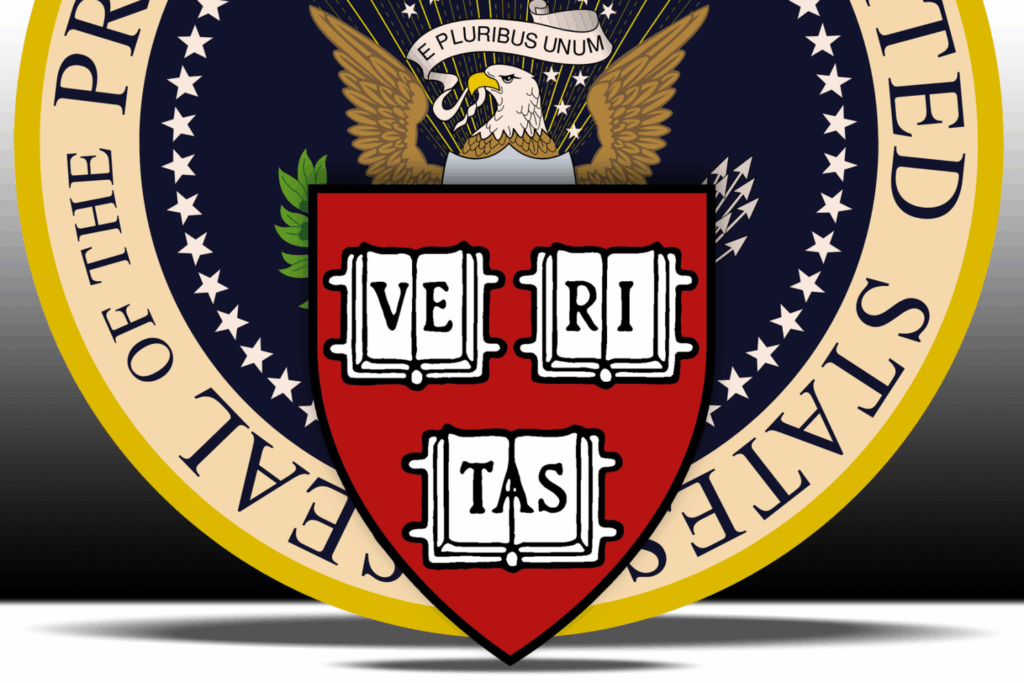
Image: Harvard University logo superimposed on the US presidential seal (Credit: The Chronicle)
By Tatiana Teixeira* [Release] [Trump 2.0] [Education] [Universities] [Harvard]
On August 7, 2025, at 4:00 PM (Brasília time), the National Institute of Science and Technology for Studies on the United States (INCT-INEU) will host the conference “University Autonomy, Academic Freedom, and Politics in the US under Trump.” The lecture will be delivered by Dr. Alex Keyssar, professor at Harvard University, and streamed live on the INCT-INEU YouTube channel.
Alexander Keyssar holds the Matthew W. Stirling Jr. Chair as Professor of History and Social Policy at Harvard. According to his institutional bio, his work focuses on historical questions with direct relevance to contemporary political life. He is the author of The Right to Vote: The Contested History of Democracy in the United States (2000/2009, Basic Books), which was recognized as the best book in U.S. history by both the American Historical Association and the Historical Society. The book was also a finalist for the Pulitzer Prize and the Los Angeles Times Book Award. In Brazil, this landmark work was published by Editora Unesp in 2014. His most recent book, Why Do We Still Have the Electoral College? (Harvard University Press, 2020), is a key reference on the topic and was named Book of the Year by The New Statesman (UK) in 2020.
Daily monitoring of leading U.S. newspapers makes it clear: the topic of this conference is both timely and urgent. With the possible exception of echoes from the McCarthy era, the situation may have no historical precedent. The implications for American society—and potentially for global academic and democratic institutions—are serious and far-reaching.
The repression of critical thought in the United States today takes many forms. It includes the instrumentalization of educational policy for ideological ends—through the capture of the Department of Education, attacks on DEI (Diversity, Equity, and Inclusion) programs, and the revision of school curricula. It is also manifest in the persecution of students and faculty, both domestic and international. Above all, it reveals itself in the direct, targeted assaults on American universities—including Harvard, Columbia, Brown, Cornell, Northwestern, UPenn, and Princeton—through budget cuts, bans on foreign student enrollment, and institutional interference.
The objective appears to be the slow asphyxiation of these institutions: to dismantle, disfigure, and defund them, eroding their identity and autonomy until their very existence is threatened.
Learn more: Visit the Diálogos INEU playlist and watch past episodes on the subject.
Follow the story: The Chronicle continues to monitor the Trump 2.0 administration’s decisions in the fields of education and anti-DEI policy.
Since the beginning of the year, the new administration has intensified its anti-intellectual rhetoric, framing universities, dissident voices, scientific knowledge, and the arts not as pillars of democracy, but as enemies to be silenced or co-opted. What we are witnessing in this fleeting present is an attempt to rewrite—or erase—the past, while restricting who gets to imagine and shape the future. Truth itself becomes contested—whether in the form of fact or fiction.
Dr. Keyssar’s lecture is, therefore, an event of broad interest and critical relevance. 
Event Information
Conference: University Autonomy, Academic Freedom, and Politics in the US under Trump
Speaker: Dr. Alex Keyssar (Harvard University)
Date: August 7, 2025
Time: 4:00 PM (Brasília time)
Format: Live on YouTube
No prior registration required
***
* Tatiana Teixeira is Editor-in-Chief at OPEU.
** To learn more about OPEU or contribute articles, contact Editor Tatiana Teixeira at tatianat19@hotmail.com.
For newsletter information, press inquiries, or other matters, contact Tatiana Carlotti at tcarlotti@gmail.com.
Subscribe to our newsletter to receive OPEU content by email.
Follow OPEU on Instagram, Twitter, Linkedin and Facebook for daily updates.
Comment, share, send suggestions, and join our community.
We are a nonprofit research observatory focused on the United States,
offering weekly, free content to the public.