I hear you, America
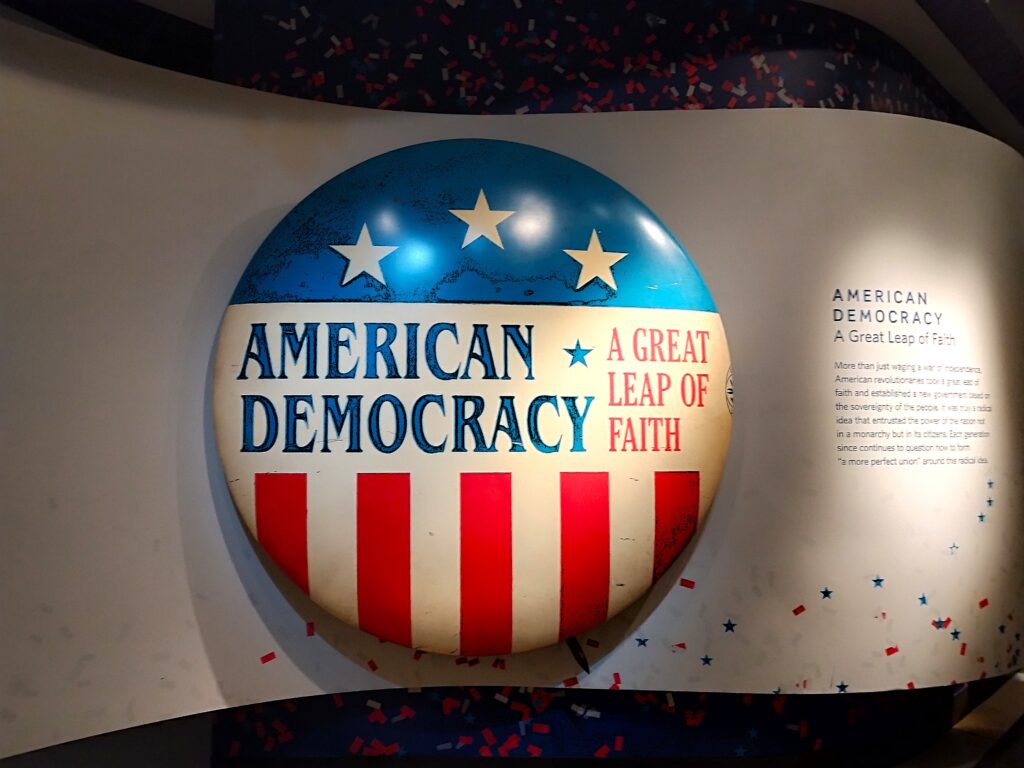
National Museum of American History, Washington, D.C., July 2025 (Credit: Tatiana Teixeira/Personal Archive)
Signs of Corrosion of the American Democracy, they are all there
By Tatiana Teixeira* [Informe OPEU] [Trump 2.0] [American Democracy] [US Politics]
When I saw the news today about the federalization of D.C.’s police, I was seized by not-so-sweet memories—family memories, collective memories, historical memories of a whole continent, of so many voices, minds, and hearts forever silenced by dictatorship. Countries and entire populations subjugated by the force of merciless and tyrannical men and theirs regimes, backed by something perhaps even more (or as much as) despotic to us, up North.
And this “thing,” at home, enforced a kind of selective tyranny—some deserved the best, others did not. This was in the past. But the past never passed. It is here, and now, haunting us again and again. Bringing the loss of ourselves, and threatening us with the promise of fear, moral emptiness, starvation of humanity, and deprivation of the future. Making us hide our desires, stifle our drive for life, and abandon our dreams. Because we lose our dreams when we have no horizon to look toward.
About how dreams start to change or disappear even before the hijacking of rights and the full implementation of terror, I strongly recommend Third Reich of Dreams: The Nightmares of a Nation, by Charlotte Beradt. A small but very powerful book. Mireille Juchau wrote an honest and worth-reading review about it for The New Yorker
Huge and dangerous steps have already been taken against democracy, beyond any red line of decency, respect, rationality, and normality. When I watched the distressing outburst of MSNBC host Rachel Maddow, warning of the growing US ‘dictatorship’ under Trump, all the signs came so clearly to my mind. And yet, they keep moving forward, because no one is stopping them.
This is not exactly an article. But I didn’t know where else to say it, where else to put these words. I hear you, America. I—we—have been there not so long ago. And it is not a comfortable or quiet place. It is cold and gray, and it makes us rain inside.
I know what it is like to wake up every day not knowing what will happen—what the next draconian decision will be, the one that could change my life in a blink, without asking for my permission. I know what it is like to live a life hanging by a thread.
But guess what—better days will come, eventually, and dog days will be over. They have to.
I hear you, America. I hear you.
I take this opportunity to remind you that literature can help us heal and survive, and these are my thoughts for you all. Take your time. Grab a cushion. Sit down. Take a few deep breaths, just for a moment.
 Amherst, MA, July 2025 (Credit: Tatiana Teixeira/Personal Archive)
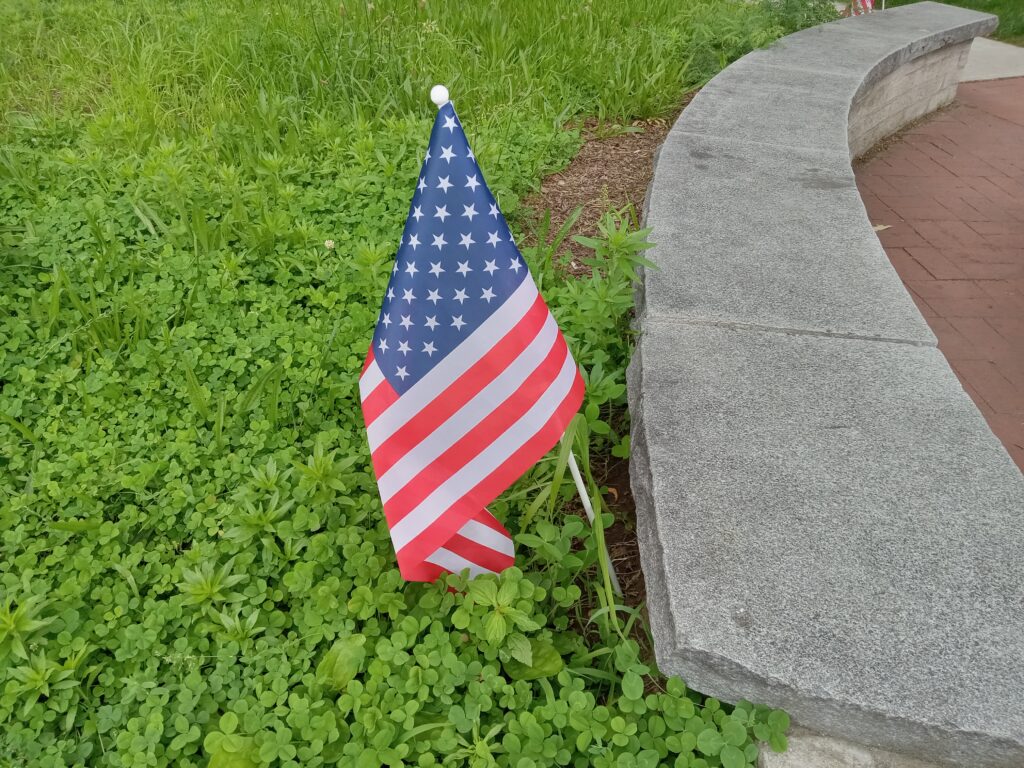 Amherst, MA, July 2025 (Credit: Tatiana Teixeira/Personal Archive)
On the Pulse of Morning
By Maya Angelou
A Rock, A River, A Tree
Hosts to species long since departed,
Marked the mastodon,
The dinosaur, who left dried tokens
Of their sojourn here
On our planet floor,
Any broad alarm of their hastening doom
Is lost in the gloom of dust and ages.
But today, the Rock cries out to us, clearly, forcefully,
Come, you may stand upon my
Back and face your distant destiny,
But seek no haven in my shadow.
I will give you no hiding place down here.
You, created only a little lower than
The angels, have crouched too long in
The bruising darkness
Have lain too long
Face down in ignorance.
Your mouths spilling words
Armed for slaughter.
The Rock cries out to us today, you may stand upon me,
But do not hide your face.
Across the wall of the world,
A River sings a beautiful song. It says,
Come, rest here by my side.
Each of you, a bordered country,
Delicate and strangely made proud,
Yet thrusting perpetually under siege.
Your armed struggles for profit
Have left collars of waste upon
My shore, currents of debris upon my breast.
Yet today I call you to my riverside,
If you will study war no more.
Come, Clad in peace, and I will sing the songs
The Creator gave to me when I and the
Tree and the rock were one.
Before cynicism was a bloody sear across your Brow and when you yet knew you still
Knew nothing.
The River sang and sings on.
There is a true yearning to respond to
The singing River and the wise Rock.
So say the Asian, the Hispanic, the Jew
The African, the Native American, the Sioux,
The Catholic, the Muslim, the French, the Greek
The Irish, the Rabbi, the Priest, the Sheik,
The Gay, the Straight, the Preacher,
The privileged, the homeless, the Teacher.
They hear. They all hear
The speaking of the Tree.
They hear the first and last of every
Tree Speak to humankind today.
Come to me, here beside the River.
Plant yourself beside the River.
Each of you, descendant of some passed
On traveller, has been paid for.
You, who gave me my first name, you,
Pawnee, Apache, Seneca, you Cherokee Nation, who rested with me, then
Forced on bloody feet,
Left me to the employment of Other seekers—desperate for gain,
Starving for gold.
You, the Turk, the Arab, the Swede, the German, the Eskimo, the Scot,
You the Ashanti, the Yoruba, the Kru, bought, Sold, stolen, arriving on the nightmare
Praying for a dream. Here, root yourselves beside me. I am that Tree planted by the River,
Which will not be moved.
I, the Rock, I the River,
I the Tree I am yours—your passages have been paid.
Lift up your faces, you have a piercing need
For this bright morning dawning for you.
History, despite its wrenching pain
Cannot be unlived, but if faced
With courage, need not be lived again.
Lift up your eyes upon
This day breaking for you.
Give birth again
To the dream.
Women, children, men,
Take it into the palms of your hands,
Mold it into the shape of your most
Private need.
Sculpt it into
The image of your most public self.
Lift up your hearts
Each new hour holds new chances
For a new beginning.
Do not be wedded forever
To fear, yoked eternally
To brutishness.
The horizon leans forward,
Offering you space to place new steps of change.
Here, on the pulse of this fine day
You may have the courage
To look up and out and upon me, the Rock, the River, the Tree, your country.
No less to Midas than the mendicant. No less to you now than the mastodon then.
Here, on the pulse of this new day
You may have the grace to look up and out
And into your sister’s eyes, and into
Your brother’s face, your country
And say simply
Very simply
With hope
— Good morning.
“On the Pulse of Morning” from On The Pulse of Morning by Maya Angelou, copyright © 1993 by Maya Angelou. Used by permission of Random House, an imprint and division of Penguin Random House LLC. All rights reserved. Source: Poets.org
The Unknown Citizen
By W. H. Auden
He was found by the Bureau of Statistics to be
One against whom there was no official complaint,
And all the reports on his conduct agree
That, in the modern sense of an old-fashioned word, he was a saint,
For in everything he did he served the Greater Community.
Except for the War till the day he retired
He worked in a factory and never got fired,
But satisfied his employers, Fudge Motors Inc.
Yet he wasn’t a scab or odd in his views,
For his Union reports that he paid his dues,
(Our report on his Union shows it was sound)
And our Social Psychology workers found
That he was popular with his mates and liked a drink.
The Press are convinced that he bought a paper every day
And that his reactions to advertisements were normal in every way.
Policies taken out in his name prove that he was fully insured,
And his Health-card shows he was once in hospital but left it cured.
Both Producers Research and High-Grade Living declare
He was fully sensible to the advantages of the Instalment Plan
And had everything necessary to the Modern Man,
A phonograph, a radio, a car and a frigidaire.
Our researchers into Public Opinion are content
That he held the proper opinions for the time of year;
When there was peace, he was for peace: when there was war, he went.
He was married and added five children to the population,
Which our Eugenist says was the right number for a parent of his generation.
And our teachers report that he never interfered with their education.
Was he free? Was he happy? The question is absurd:
Had anything been wrong, we should certainly have heard.
From Another Time by W. H. Auden, published by Random House. Copyright © 1940 W. H. Auden, renewed by the Estate of W. H. Auden. Used by permission of Curtis Brown, Ltd. Source: Poets.org.
Praise Song for the Day
By Elizabeth Alexander
Each day we go about our business, walking past each other, catching each other’s eyes or not, about to speak or speaking.
All about us is noise. All about us is noise and bramble, thorn and din, each one of our ancestors on our tongues.
Someone is stitching up a hem, darning a hole in a uniform, patching a tire, repairing the things in need of repair.
Someone is trying to make music somewhere, with a pair of wooden spoons on an oil drum, with cello, boom box, harmonica, voice.
A woman and her son wait for the bus. A farmer considers the changing sky. A teacher says, Take out your pencils. Begin.
We encounter each other in words, words spiny or smooth, whispered or declaimed, words to consider, reconsider.
We cross dirt roads and highways that mark the will of some one and then others, who said I need to see what’s on the other side.
I know there’s something better down the road. We need to find a place where we are safe. We walk into that which we cannot yet see.
Say it plain: that many have died for this day. Sing the names of the dead who brought us here, who laid the train tracks, raised the bridges,
picked the cotton and the lettuce, built brick by brick the glittering edifices they would then keep clean and work inside of.
Praise song for struggle, praise song for the day. Praise song for every hand-lettered sign, the figuring-it-out at kitchen tables.
Some live by love thy neighbor as thyself, others by first do no harm or take no more than you need. What if the mightiest word is love?
Love beyond marital, filial, national, love that casts a widening pool of light, love with no need to pre-empt grievance.
In today’s sharp sparkle, this winter air, any thing can be made, any sentence begun. On the brink, on the brim, on the cusp,
praise song for walking forward in that light.
Source: Poets.org.
Of History and Hope
By Miller Williams
We have memorized America,
how it was born and who we have been and where.
In ceremonies and silence we say the words,
telling the stories, singing the old songs.
We like the places they take us. Mostly we do.
The great and all the anonymous dead are there.
We know the sound of all the sounds we brought.
The rich taste of it is on our tongues.
But where are we going to be, and why, and who?
The disenfranchised dead want to know.
We mean to be the people we meant to be,
to keep on going where we meant to go.
But how do we fashion the future? Who can say how
except in the minds of those who will call it Now?
The children. The children. And how does our garden grow?
With waving hands—oh, rarely in a row—
and flowering faces. And brambles, that we can no longer allow.
Who were many people coming together
cannot become one people falling apart.
Who dreamed for every child an even chance
cannot let luck alone turn doorknobs or not.
Whose law was never so much of the hand as the head
cannot let chaos make its way to the heart.
Who have seen learning struggle from teacher to child
cannot let ignorance spread itself like rot.
We know what we have done and what we have said,
and how we have grown, degree by slow degree,
believing ourselves toward all we have tried to become—
just and compassionate, equal, able, and free.
All this in the hands of children, eyes already set
on a land we never can visit—it isn’t there yet—
but looking through their eyes, we can see
what our long gift to them may come to be.
If we can truly remember, they will not forget.
Copyright Credit: Miller Williams, “Of History and Hope” from Some Jazz A While: Collected Poems. Copyright © 1999 by Miller Williams. Used with the permission of the poet and the University of Illinois Press.
Source: Some Jazz a While (University of Illinois Press, 1999)/Poetryfoundation.org.
This Land is Your Land
By Woody Guthrie
This land is your land, this land is my land
From California to the New York island;
From the red wood forest to the Gulf Stream waters
This land was made for you and me.
As I was walking that ribbon of highway,
I saw above me that endless skyway:
I saw below me that golden valley:
This land was made for you and me.
I’ve roamed and rambled and I followed my footsteps
To the sparkling sands of her diamond deserts;
And all around me a voice was sounding:
This land was made for you and me.
When the sun came shining, and I was strolling,
And the wheat fields waving and the dust clouds rolling,
As the fog was lifting a voice was chanting:
This land was made for you and me.
As I went walking I saw a sign there
And on the sign it said “No Trespassing.”
But on the other side it didn’t say nothing,
That side was made for you and me.
In the squares of the city, in the shadow of the steeple,
By the relief office I seen my people;
As they stood there hungry, I stood there asking
Is this land made for you and me?
Nobody living can ever stop me,
As I go walking that freedom highway;
Nobody living can ever make me turn back
This land was made for you and me.
Source: The Kennedy Center.
Pledge Allegiance
By Natalie Scenters-Zapico
I tap-tap-tap the window, while my mother smiles and mouths, Tranquila. I tap-tap the glass, my mother a fish I’m trying to summon.
I tap until a border agent says: Stop. Until a border agent shows me the gun on her belt. My childhood was caught
on video border agents deleted every three months. I thought myself a movie star blowing kisses at the children
selling chiclets on the bridge. My cruelty from the backseat window caught on video—proof I am an American. The drug sniffing
dogs snap their teeth at my mother detained for her thick accent, a warp in her green card. My mother who mouths, Tranquila.
My mother’s fingers dark towers on a screen for the Bioten scan. Isn’t it fun? says the border agent. The state takes a picture
of my mother’s left ear. Isn’t it fun? I tap-tap-tap the glass and imagine it shatters into shiny marbles. A marble like the one
I have in my pocket, the one I squeeze so hard I hope to reach its blue swirls. Blue swirls I wish were water I could bring to my mother
in a glass to be near her. Friends, Americans, countrymen lend me your ears! But only the border agent replies, Do you know the pledge of allegiance?
She points to a flag pinned on a wall. I do, so I stand and pledge to the country that says it loves me so much, it loves me so much it wants to take
my mother far away from me. Far away, to the place they keep all the other mothers to sleep on rubber mats and drink from rubber hoses.
Don’t worry, says the border agent, we will take good care of your mommy. My mother mouths, Tranquila. Her teeth, two rows of gold I could pawn
for something shiny, something shiny like the border agent’s gun. Friends, Americans, countrymen lend me your ears, so I can hear
my mother through bulletproof glass, so I can hear her over the roar of American cars crossing this dead river by the wave of an agent’s pale hand.
Copyright © 2020 by Natalie Scenters-Zapico. Originally published in Poem-a-Day on October 1, 2020, by the Academy of American Poets. Source: Poets.org.
First They Came
By Tatiana Teixeira, adapted from Martin Niemöller’s original quote
When the Nazis [ICE] came for the communists [immigrants], I kept quiet; I wasn’t a communist [immigrant].
When they came for the trade unionists [fired thousands of public employees], I kept quiet; I wasn’t a trade unionist [public employee].
When they locked up the social democrats [pro-Palestine students], I kept quiet; I wasn’t a social democrat [pro-Palestine].
When they locked up the Jews [homeless people and congressmen from the opposite party, deleted historical and official websites and archives, dismantled redistributive policies of social inclusion, banned books in libraries, cut funding for public colleges and universities, and for underprivileged students], I kept quiet; I wasn’t a Jew [didn’t like politics and didn’t care for education].
When they came for me, there was no one left to protest. 
* Tatiana Teixeira, PhD is editor-in-chief of the Observatório Político dos Estados Unidos – OPEU. She has just spent six weeks in the United States participating in the American Politics and Political Thought course, part of the Civic Initiative at the Donahue Institute, University of Massachusetts Amherst (UMass). SUSI 2025 is sponsored by the U.S. Department of State and administered by the University of Montana (UM). All works resulting from the program reflect the sole initiative and responsibility of the researcher and do not represent any endorsement or alignment with U.S. government policies, past or present. Contact: tatianat19@hotmail.com.
** This Informe OPEU does not necessarily reflect the opinion of OPEU or INCT-INEU.
*** To learn more about OPEU or contribute articles, contact Editor Tatiana Teixeira at tatianat19@hotmail.com.
For newsletter information, press inquiries, or other matters, contact Tatiana Carlotti at tcarlotti@gmail.com.
Subscribe to our newsletter to receive OPEU content by email.
Follow OPEU on Instagram, Twitter, Linkedin and Facebook for daily updates.
Comment, share, send suggestions, and join our community.
We are a nonprofit research observatory focused on the United States,
offering weekly, free content to the public.