A Short Note on the US Threat of Tariffs on Brazil, GATT Rules and BRICS
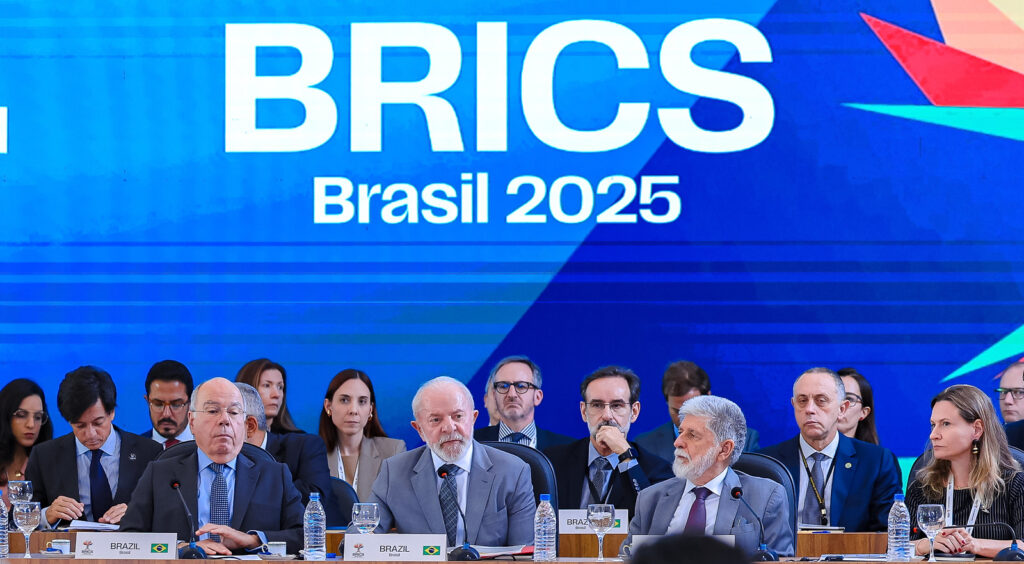
President of the Republic, Luiz Inácio Lula da Silva, during the opening of the First Sherpa Meeting of the Brazilian Presidency of BRICS. Itamaraty Palace, Brasília – DF, February 22, 2025. Photo: Ricardo Stuckert/PR/Flickr
Dossier: “Tariffs: Trump vs. the World”
By Rômulo Tavares Ribeiro* [Informe OPEU] [Trump 2.0] [Tariffs] [Trade] [Brics] [Brazil]
The Tariff Threat
On July 9th of 2025, the President of the United States of America published a letter threatening the Federal Republic of Brazil with an overwhelming increase in tariffs for goods exported to the US. In his letter, he mentioned reasons that lie outside the reach of trade policy, as well as alleged cumulative commercial losses against the US in the bilateral relationship. The trade policy dimension of this letter is the scope of this short note.
Similarly to what he had done concerning many other countries, the US President announced an impressive raise in the import tax rate against Brazil, in this case to be due on August 1st of 2025. He announced an increase of up to 50% ad valorem, with a trigger for a new round if Brazil adopts reciprocal treatment, proportional to the possible Brazilian response.
Besides other elements that lie outside the scope of this note, the letter from the US President indicates that the rise in tariffs might not occur if Brazilian companies moved production plants to the U.S. In other words, the threat came with an associated conditionality. In verbis, “As you are aware, there will be no Tariff if Brazil, or companies within your Country, decide to build or manufacture product within the United States and, in fact, we will do everything possible to get approvals quickly, professionally, and routinely–in other words, in a matter of weeks.”
Moreover, as a result of alleged discriminatory treatment against American companies dedicated to Digital Trade, the US President said that the United States Trade Representative (USTR) would be called upon to initiate an investigation based on Section 301 of America’s Trade Act.
In fact, the demanded Initiation of Section 301 investigation of Brazil’s alleged unfair trading practices by the USTR took place on July 15th 2025, directed to various subjects, namely, “digital trade and electronic payment services; unfair, preferential tariffs; anti-corruption interference; intellectual property protection; ethanol market access; and illegal deforestation are unreasonable or discriminatory and burden or restrict U.S. commerce”. This variety of subjects shows an appetite of the USTR to attend US President’s direction, opening a front of bilateral disputes with Brazil under Section 301.
USTR and the Rules of GATT
As the USTR has explained in the investigation against China on semiconductors, published at the Federal Register [equivalent to Brazilian Federal Official Gazette, Rev..] of December 30, 2024,
“Section 302(b)(1)(A) of the Trade Act of 1974, as amended (Trade Act), authorizes the U.S. Trade Representative to initiate an investigation to determine whether an act, policy, or practice of a foreign country is actionable under Section 301 of the Trade Act.
Actionable matters under Section 301 include acts, policies, and practices of a foreign country that are unreasonable or discriminatory and burden or restrict U.S. commerce. An act, policy, or practice is unreasonable if, while not necessarily in violation of, or inconsistent with, the international legal rights of the United States, it is otherwise unfair and inequitable”.
This explanation of Section 301 of the Trade Act of 1974 reminds us that the rules to be observed by the US trade authority should have a direction to guarantee final decisions based on a previous technical assessment. But, also, for any due investigation under the Trade Act, emphasis should be given to acts, policies or practices that may be inconsistent with international legal rights of the United States. This point must be highlighted. What is expected by the international community is that these legal rights of a country be those rights which are internationally recognised as regulating its interaction with other countries.
It is appropriate to consider that the disciplines of the World Trade Organisation (WTO) form the set of internationally recognised legal rights of each member country on trade topics covered by its agreements. It is well-known that one of the most important aspects of trade policy under the WTO’s rules is the fair and balanced administration of tariffs by the member countries.
But from the perspective of WTO disciplines, we argue that there is an inconsistency between the conditionality presented by the US president and the provisions of the General Agreement on Tariffs and Trade (GATT)–a key reference of the US-led post-World War II international regulation of trade and tariffs, absorbed and expanded by the creation of the WTO in the last decade of the 20th century. It is not difficult to see that the GATT does not provide policy space for the adoption of such a conditionality.
The most important pillars of the Agreement are the General Most Favoured Nation Treatment (MFN) and the Non-discrimination principles.
On the one hand, the MFN principle is materialised on Article I as some sort of foundational principle, saying that “With respect to customs duties and charges of any kind imposed on or in connection with importation or exportation or imposed on the international transfer of payments for imports or exports, and with respect to the method of levying such duties and charges, and with respect to all rules and formalities in connection with importation and exportation, and with respect to all matters referred to in paragraphs 2 and 4 of Article III, any advantage, favour, privilege or immunity granted by any contracting party to any product originating in or destined for any other country shall be accorded immediately and unconditionally to the like product originating in or destined for the territories of all other contracting parties.”
On the other hand, Article III refers to Non Discrimination, or, as usually put, National Treatment, precluding that measures taken by member countries be directed towards a discriminatory treatment, in a way that “The products of the territory of any contracting party imported into the territory of any other contracting party shall be accorded treatment no less favourable than that accorded to like products of national origin in respect of all laws, regulations and requirements affecting their internal sale, offering for sale, purchase, transportation, distribution or use.”
 “Liberation Day”: President Donald Trump signs an executive order imposing tariffs on April 2, 2025, in the White House gardens in Washington, D.C. Credit: The White House/Flickr
 “Liberation Day”: President Donald Trump signs an executive order imposing tariffs on April 2, 2025, in the White House gardens in Washington, D.C.
 It must be added that the WTO membership allows important courses of action by countries who believe to be adversely affected by unfair practices. This is the case of GATT Articles VI and XVI, as well as of the Agreements on Antidumping and on Subsidies, which regulate how to remedy damages to the commercial performance derived from unfair practices. These disciplines codify a fair and transparent way for conducting investigations, recognized by all countries taking part of the multilateral system embodied on the WTO agreements.
Another alternative for measures is the recourse to safeguards, in line with the disciplines of GATT Article XII, which says that under certain circumstances and with predefined limitations, “any contracting party, in order to safeguard its external financial position and its balance of payments, may restrict the quantity or value of merchandise permitted to be imported”. In this case, the country may adopt temporary measures to work on an upsurge of imports damaging the national economy and risking the welfare of its citizens. The multilateral system offers this possibility (both through Article XII and Article XIX) of safeguard measures to provide space to countries that see themselves as lagging behind a rapidly changing competitive economic scenario.
Lastly, Articles XX and XXI of GATT, on General and Security Specific exceptions, respectively, give member countries the flexibility to except multilateral rules to avert damaging essential needs, from the human condition to the security of their societies.
However, no flexibility or exception provides an authorization for a member country to use increased tariffs as a tool to force the relocation of productive plants from another country to alleviate the result of its balance of trade.
In fact, in a wider perspective, the WTO agreements are not designed to allow for such a conditionality, be it in the form of a countervailing measure or in an extreme case involving the right to retaliate. The bid of not rising tariffs if a foreign country exports industries to your territory–what we propose to name as “tariffshoring”–lies beyond the scope of remedying practices seen as injuring market access or impairing rights. On the contrary, it seems to be a prima facie violation of the National Treatment principle, for it states that some foreign industries of another member country will receive national treatment if and only if they become national industries.
Besides the adoption of a conditionality that constitutes unjustifiable discrimination against a country, the argument of an unfair or inequitable trade relationship is undermined from the very beginning by the fact that the US hold more than a decade of recurrent surpluses on the bilateral trade of goods and services with Brazil.
Beyond the possible dire negative consequences to Brazilian exporters, as well as to American importers and consumers (from basic products like coffee and orange to steel and aircraft), one important aspect of Mr Trump’s direction of demanding a relocation of industries through a tariff threat is that it challenges the technical reputation of the American trade policy authorities, risking their credibility to voice demands of reforms of the rules and procedures of WTO.
BRICS and the WTO Dispute Settlement Body
In fact, the deliberate use of trade policy tools in a way inconsistent with GATT/WTO rules, together with a persistent American veto of allowing the Dispute Settlement Appellate Body to work at its full capacity, deprives the multilateral trade system of constructive contributions from the US. Hence, a final comment on BRICS is quite necessary, for the tariff war is a major economic challenge faced by this young organisation. The kind of policy the US currently adopts against several countries may end up fostering an even faster expansion of the BRICS group. If this push translates into an increased trade within the bloc, it is natural to foresee the occurrence of trade disputes in the coming future within the BRICS.
One of the pillars of the multilateral system since the conclusion of the Uruguay Round and the creation of WTO [1994 and 1995, respectively, Rev.] was not so much the promises made by the advocates of free trade as an open road to prosperity, but the objective existence of a well-known and generally accepted principles guiding the settlement of disputes on the trade and investment themes touched upon by the WTO disciplines.
This is not the case only for BRICS countries, of course. The importance of restoring, to some extent, the mechanism is evidenced by different initiatives. In the absence of a functional Dispute Settlement Body in Geneva, member countries of the WTO–like the European Union and Canada in 2019; and 18 countries under the Multi-Party Interim Appeal Arbitration Arrangement (MPIA), in 2020–decided to settle disputes through arbitration, having WTO rules as the law of reference, utilizing the Article 25 of the Dispute Settlement Understanding.
Since then, many countries have decided to do the same, joining the Mechanism and making MPIA represent countries that account for almost 60% of the overall world trade.
Having this in mind, it is appropriate that BRICS countries move to preserve the WTO’s dispute settlement mechanism, for it makes no sense to BRICS to deprive itself of the benefits of a well-developed and member-driven mechanism like that of the WTO. On the Rio de Janeiro Declaration of 6th July of 2025, BRICS countries reiterated their support “for the rules-based, open, transparent, fair, inclusive, equitable, non-discriminatory, consensus-based multilateral trading system with the World Trade Organization (WTO) at its core”.
This is why this article argues that BRICS countries are in the right direction to devote part of their energy to keep pushing the revival of the WTO, but, coherently, it is crucial to build or join an alternative mechanism based on the rules of the WTO, with appropriate adaptations, that will allow the settlement of trade disputes between them.
WTO: “BRICS countries are in the right direction”, says Mr. Tavares Ribeiro. Credit: WTO/Flickr
 WTO: “
This mechanism shall be based on international rules of law, as well as on good faith, as did GATT in 1947, “Recognizing that their relations in the field of trade and economic endeavour should be conducted with a view to raising standards of living, ensuring full employment and a large and steadily growing volume of real income and effective demand, developing the full use of the resources of the world and expanding the production and exchange of goods. Being desirous of contributing to these objectives by entering into reciprocal and mutually advantageous arrangements directed to the substantial reduction of tariffs and other barriers to trade and to the elimination of discriminatory treatment in international commerce”.
Multilateralism with Pragmatism
In this article, it has been claimed that the announced measures by the President of the US against Brazil, on July 9th, 2025, encompassed one clear violation of a fundamental discipline of the WTO, to the extent that it involves the administration of tariffs in a way to force the export of industries into the US.
We have named this conditionality presented by the President of the US as tariffshoring. This procedure undermines the legitimacy of the US Trade Representative to voice demands for reforms on the WTO, like those presented as the American reasons to block the admission of judges to recompose the Appellate Body.
It has also been stated that, from the perspective of BRICS countries, the paralysis of the Appellate Body in Geneva makes evident the case for an alternative use of WTO’s disciplines, in favour of those countries that have a rising share of global GDP and are really compromised with a shared prosperity.
As a corollary, the technical implementation of the decision taken by the Ministers of Trade of the BRICS of adopting the BRICS Declaration on WTO Reform and Strengthening of the Multilateral Trading System may include a compromise of all BRICS countries to engage in the MPIA mechanism, as an officially accepted mechanism to settle possible bilateral trade disputes within the bloc, as a stimulus for the growth of trade between them. 
* Rômulo Tavares Ribeiro is economist. The views presented are those of the individual author and not necessarily those of any organization or group he is affiliated with. Contact: romulograz@hotmail.com.
** First version received on July 27, 2025. Reviewed by Tatiana Teixeira. This Informe OPEU does not necessarily reflect the opinion of OPEU or INCT-INEU.
*** To learn more about OPEU or contribute articles, contact Editor Tatiana Teixeira at tatianat19@hotmail.com.
For newsletter information, press inquiries, or other matters, contact Tatiana Carlotti at tcarlotti@gmail.com.
Subscribe to our newsletter to receive OPEU content by email.
Follow OPEU on Instagram, Twitter, Linkedin and Facebook for daily updates.
Comment, share, send suggestions, and join our community.
We are a nonprofit research observatory focused on the United States,
offering weekly, free content to the public.